
Cross-Margin vs Isolated Margin: What Killed a $45B Fund

Bottom line: In July 2026, more than 1.2 million Korean retail investors and a reported $45B AI hedge fund were liquidated on the same trade, in the same month, at roughly 4x leverage. Neither was wrong about the market. Both were destroyed by margin structure: correlated positions sharing one pool of collateral, with a counterparty holding the exit. If you trade with leverage, the four questions at the end of this article matter more than the multiple you pick.
Why Situational Awareness collapsed, and why Korean retail collapsed with it
Start in Seoul. On 16 July the KOSPI index fell 6.37%, taking it more than 27% below its June high.
More than 1.2 million leveraged retail accounts hit margin calls. Between 320,000 and 360,000 were forcibly liquidated, and investors in their twenties and thirties made up 62% of them. Margin loan balances had passed 60 trillion won in May, an all-time record. (CNBC, 20 July 2026)
The leverage sat in Samsung Electronics and SK Hynix, the two largest listed companies in the country. Together they make up more than half of the KOSPI, so a portfolio holding both was not diversified. It was one position wearing two tickers.
Two weeks earlier, the same trade had done the same thing at the opposite end of the market.
Leopold Aschenbrenner, a former OpenAI researcher, ran a fund called Situational Awareness. Heading into July it was up 439%.
His bet was the most crowded idea on Wall Street, expressed cleanly. Long the physical AI build-out of chips, data centres and power. Short the software companies AI was expected to disrupt.
In July, momentum reversed on both legs at once. The AI longs fell 40 to 50%. The software shorts rallied. Margin calls arrived from his prime brokers, the banks that finance a hedge fund's positions. (CNBC, 31 July 2026)
He was forced to sell his listed book to Citadel at a discount. The fund finished July down 67%. Reported leverage was roughly four times capital. Not a hundred times. Four. (CNBC, 31 July 2026)
One side of this story is a million retail investors with a leverage app. The other is the most sophisticated AI investor of his generation. Same month, same trade, same ending.
Why leverage multiples do not cause blowups
Everyone reads a blowup and reaches for the leverage multiple. It is the wrong variable. Three structural features did the damage, and none of them is the number in front of the x.
Correlation wearing a costume. Seven tickers can be one bet. Chips, power, data centres and a short against software all express a single view about AI capital spending. When that view reverses, every line item moves together. Korean retail hit the same wall for a simpler reason: two stocks were half the index.
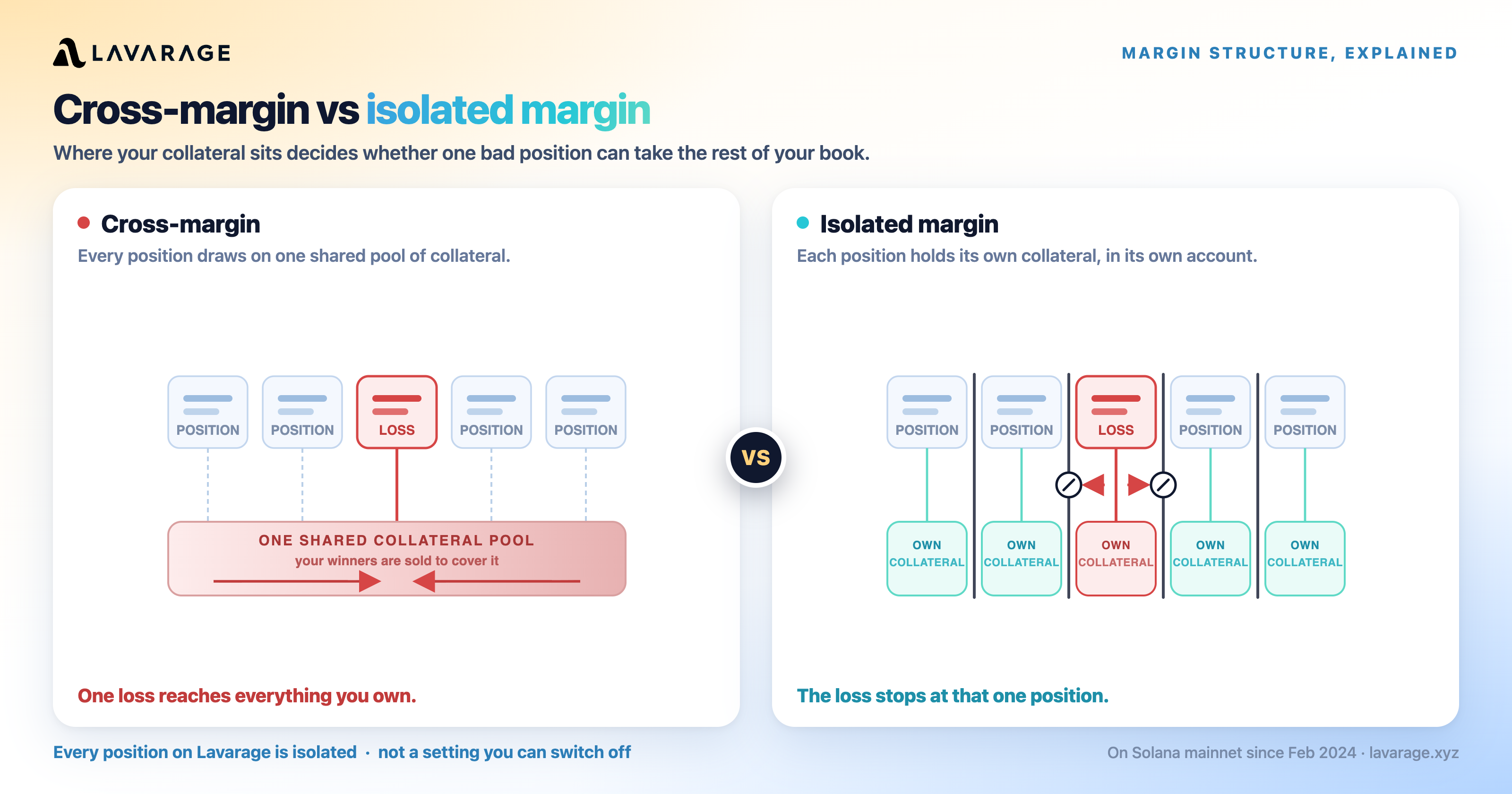
Cross-margin. In a cross-margined account, every position draws on one shared pool of collateral. A loss anywhere reduces the collateral supporting everything else. Your surviving positions get sold to cover your losing ones, at the worst price, in the worst week. This is the mechanism that turns a bad month into a terminal one, and it is how a book goes from up 439% to down 67% while its owner never changes his mind.
Someone else owns the exit. A margin call is a decision made by a risk desk, not by the market and not by you. Aschenbrenner did not choose to sell to Ken Griffin at a discount; his prime brokers chose it for him. Korean retail did not choose 360,000 forced liquidations either. In both cases the position was closed by a counterparty, on the counterparty's timetable.
Cross-margin vs isolated margin: what the difference actually is
Cross-margin is a margin mode in which every open position draws on one shared pool of collateral. Profit on one position supports the margin requirement of another, and a loss anywhere reduces the collateral backing everything else. It uses capital efficiently, and it allows a single losing position to liquidate an entire account.
Isolated margin is a margin mode in which each position holds its own collateral in its own account. A loss is capped at the collateral assigned to that position and cannot reach any other. It uses capital less efficiently than cross-margin, and it stops one losing position from cascading into the rest of a portfolio.
| | Cross-margin | Isolated margin |
| --- | --- | --- |
| Collateral | One shared pool across all positions | Separate collateral for each position |
| Contagion | A loss anywhere can liquidate everything | A loss is contained to that position |
| Capital efficiency | Higher, because unused margin supports other trades | Lower, because each position is funded on its own |
| Worst case | The whole book | That one position |
| Who closes you | A risk desk's discretion, or a pooled rule | A liquidation level fixed before you open |
Cross-margin is not a scam. It is more capital-efficient, which is exactly why professionals use it. The trade-off is that efficiency travels in both directions, because shared collateral means shared fate. If you are new to how borrowing against a position works at all, start with what leverage trading is.
Why adding to a winning position moves your liquidation price
This is the part that catches good traders, and it has nothing to do with the multiple you started at.
Assume a position is liquidated when the loan reaches 90% of the position's value. That ratio, the loan-to-value or LTV, is the standard trigger. The numbers below are a simplified illustration and ignore interest and fees.
Open with $1,000 of your own money and $1,000 borrowed. The position is worth $2,000, the loan is $1,000, and LTV is 50%. Liquidation arrives when the position falls to about $1,111, which is a 44% drop you can survive.
Now the trade works and the position is worth $2,400. You feel good, so you borrow another $1,000 and buy more. The position is now $3,400 against a $2,000 loan, and liquidation arrives at about $2,222. That is only 35% below where you are standing.
Compound a few more times and the survivable fall is closer to 28%. Your leverage looked modest at every single step, and your distance to liquidation shrank at every single step.
That is the whole trap. Every top-up buys size and sells back room. We watch traders walk down this ladder on our own order book, get comfortable, and then get taken out by a fall they would have survived at their original entry.
Four questions before you add leverage to anything
1. If this position goes against me, what else that I own gets sold to pay for it?
2. Do I know the exact price at which I am liquidated, before I open the trade?
3. Who decides that price, and can they change it while I am in the position?
4. Am I holding seven things, or one thing seven times?
Most traders can answer the fourth. Very few can answer the first three about the venue they are using right now.
How isolated margin works in spot margin on Solana
Lavarage is spot margin for any token on Solana, and these questions are why the structure looks the way it does. If you are coming from a centralized exchange, the differences are worth reading first.
Every position is isolated. Each one is its own on-chain account with its own collateral and its own liquidation level, taken from the lender's offer. There is no shared pool, no insurance fund socializing another trader's loss onto you, and no auto-deleveraging that closes your winning position to repair someone else's.
Liquidation runs on a published rule rather than a phone call. The LTV that closes your position is set in the offer you borrow from, before you open it, and it does not move because a desk got nervous.
You also hold the real token. Spot margin means your position is the asset itself, not a synthetic that tracks it.
Now the honest part. None of this makes you safe. Any single position can still go to zero, and on volatile assets plenty of them do. What isolated margin removes is contagion, the specific failure that took a million retail accounts and a $45B fund in the same month. Position sizing is still your job, and so is answering question two before you click.
Right thesis, wrong structure, is the most expensive trade there is.
Lavarage has been live on Solana mainnet since February 2024, with $200M+ traded by 10,000+ users across hundreds of tokens with live margin markets.
Frequently asked questions
What is isolated margin?
Isolated margin assigns separate collateral to each position, so a loss is capped at that position's own collateral and cannot touch the rest of the account. Cross-margin instead pools collateral across every position, which is more capital-efficient but lets one loss drain the whole book.
Does isolated margin prevent liquidation?
No. Isolated margin does not reduce the chance that any single position is liquidated, and each position can still go to zero. What it prevents is contagion: a liquidated position cannot force the sale of your other positions.
Why did Situational Awareness collapse?
The fund ran roughly 4x leverage on a concentrated AI trade, long chips, data centres and power, short software. Both legs reversed at once in July 2026, its prime brokers issued margin calls, and it was forced to sell its listed book to Citadel at a discount, finishing the month down 67%.
Is cross-margin safer than isolated margin?
Neither is automatically safer. Cross-margin is more capital-efficient but shares fate across positions, while isolated margin contains losses and funds each position separately. The right choice depends on correlation: the more correlated your positions, the more dangerous cross-margin becomes.
Why does adding to a position move your liquidation price?
Each top-up increases the loan against the position faster than it increases your buffer. At a 90% liquidation LTV, a position opened with equal collateral and borrowing survives a roughly 44% fall; after one top-up it survives about 35%.
Nothing here is financial advice. Trading with leverage carries risk of loss, including liquidation. Figures for Situational Awareness and the Korean market are as reported by CNBC in July 2026; the fund's assets under management are privately held and reported figures vary by outlet.